
Which model of GPU waterblock is better

Ionut

New member
Hello everyone!
Can you please tell me which of the following models of GPU waterblock has higher performance and, if the information is available, by how much (approximately):
- Eisblock Aurora Acryl;
- Core;
- ES (single slot).
Right now I have the Eisblock (on a reference Inno3D 4080 Super) and.....I'm not very satisfied with the temperatures that I have. The GPU is in a dedicated loop (I have dual loop) with a D5 pump and 2 radiators: a 360 and a 240, both 30 mm thick. For this kind of potential cooling performance, I was expecting sub 50 degrees core temperatures; instead I have, on average, around 55 degrees when I game. And it's not about the contact: I'm using a Thermal Grizzly Kryosheet (0.2 mm thickness) and this has only two mounting results: it works or it's not, there's no "in between". Also, this is not an airflow issue: I'm using an open air case, with all the fans on intake (fresh air), roughly 25 degrees room temperature, water temperature at around 34 degrees in load (about 28 degrees in idle). If either of the other waterblocks I've mentioned is significantly better, then call me interested.....
Thank you for your prompt reply!
 

Eddy

Iceman
Staff member
The performance of all the coolers mentioned is basically identical, as the base of the cooler—the copper part—is the same on all of them. The ES version only has a slightly different water flow path, but that doesn’t change the cooling performance.

There’s a flaw in your reasoning. It’s actually much easier to get a 4090 or 5090 below 50 °C than a 4080 or 5080. The reason is that the 4080 and 5080 have a much higher heat output per mm² than the larger cards. That makes them significantly harder to cool. Getting them below 50 °C is very difficult and would only be possible with extremely high flow rates and even more radiator surface area.

At that point, only liquid metal would really help.
 

Ionut

New member
Wow...that was a quick reply, thank you!
I see now....so, 55 degrees is actually OK, right?
Anyway.....if more flow and more radiator surface is needed....then I can turn my two loops into one....using both pumps in parallel (for double the flow) and using all of my four radiators (2 x 360 and 2 x 240) to cool the GPU and CPU at once. I wonder, however, if a D5 pump can push the coolant trough that loop (since I would run them in parallel, the head would be equal to the one of a single pump). So....my loop(s) have the following characteristics:
- radiators are rated for 0.22 psi pressure drop (each);
- CPU block (Core 1 LT) is rated for 1.01 psi pressure drop;
- GPU block (Eisblock) is rated for....maybe 0.62 psi pressure drop? (doesn't make much sense, the GPU loop needs more pump rpm to keep up with the CPU loop in terms of flow....);
- I'm not using any hard-90 degree fittings, only double-45 when I have to (smoother path for the coolant); also using some 45 and 30-degree fittings, depending of the direction I need.....
Should I give it a try?
 

Eddy

Iceman
Staff member
You’re overthinking this a bit. Just as an example, my personal system: I’m running an RTX 4080 and a Ryzen 7950X3D (with the Core 1 cooler). I have three 360 mm radiators installed, a lot of angled fittings, and six quick-disconnects, which are very restrictive. My Apex pump runs at 50% PWM, and the fans are limited to a maximum of 800 rpm. Under full load, I see around 78 °C on the CPU and about 58 °C on the GPU (rendering tests), and in this case both CPU and GPU are under full load at the same time. The ambient room temperature during the test was around 22 °C.

The pump will be sufficient. You won’t see any major improvements in your temperatures anymore. And worrying this much about whether the GPU is 2–3 °C warmer or cooler, when air coolers often run 30–40 °C hotter, is honestly a bit over the top, don’t you think?

By the way, angled fittings hardly affect flow at all. Whether you install ten 90-degree fittings or ten straight fittings makes almost no difference. You’ll barely be able to measure any difference.
 

Ionut

New member
"You’re overthinking this a bit"......yeah, you're probably right :) ....... no, definitely right :)
Are you sure about the hard-90 fittings? All over the net (youtu...e) they say it will induce resistance in the loop....., true, losing pressure, not flow, so didn't I due a good thing by not using them?
By the way, I am a little puzzled about the flow rate in the GPU loop.....if the GPU block is less restrictive than the CPU block, shouldn't I have (at least) the same flow in the GPU loop vs. CPU loop, at the same pump speed? Yet, I do not, the GPU loop's pump is running at about 3900 rpm for 4.5 l/min, while the CPU loop's pump is running at about 3400 rpm for 5 l/min......
 

Eddy

Iceman
Staff member
If you look at it very precisely, angled fittings do of course increase flow resistance and therefore also affect flow. But on the internet this topic is blown way out of proportion compared to how relevant it actually is in practice. In the end, it’s barely relevant at all. So I really wouldn’t worry about angled fittings in terms of flow or flow resistance. The worst offenders are always the coolers themselves and various quick-disconnects.

Try setting the pump in the CPU loop to 3900 rpm as well and see what happens. That’s a difference of 500 rpm after all.
You’ll never get the two loops to behave exactly the same anyway. Even different pump tops or reservoirs with integrated pumps can already cause differences, because the pump volutes often differ and the inlet and outlet designs are not identical.
That’s not something you can compare directly, or only with difficulty. And I don’t know your exact setup or which components you’re using.

But do you really have 5 L/min? That would be 300 L/h. My loop runs at around 80 L/h. And beyond roughly 120 L/h, the performance of our coolers doesn’t really improve anymore. You might squeeze out another 1–2 °C at best, but not more than that.
 

Ionut

New member
If the flowmeter doesn't lie......:)
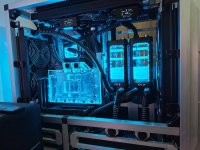
If I push both pumps to max rpm, then I have around 6 l/min on the GPU loop and 8 l/min on the CPU loop. Like I've said, for some weird reason, the CPU loop has more flow, despite being more restrictive (1 psi pressure drop on Core LT vs. 0.62 psi pressure drop on Eisblock, at least according to the reviewers.....). Both loops have the same model of pump, same model of top+reservoir combo, the same model (even the same product line) of radiators. The only differences are in the number of fittings and the length of the tubes. I've attached a picture for better representation....
 

Attachments

  • thumbnail.jpg
    thumbnail.jpg
    152.5 KB · Views: 2
Top